5 Days, 3 AI Systems: How We Automated Sales, Marketing and Business Optimization
In one week, our AI agent ecosystem built an autonomous sales machine, a marketing content pipeline, and a business metrics optimizer. Real projects, real numbers.
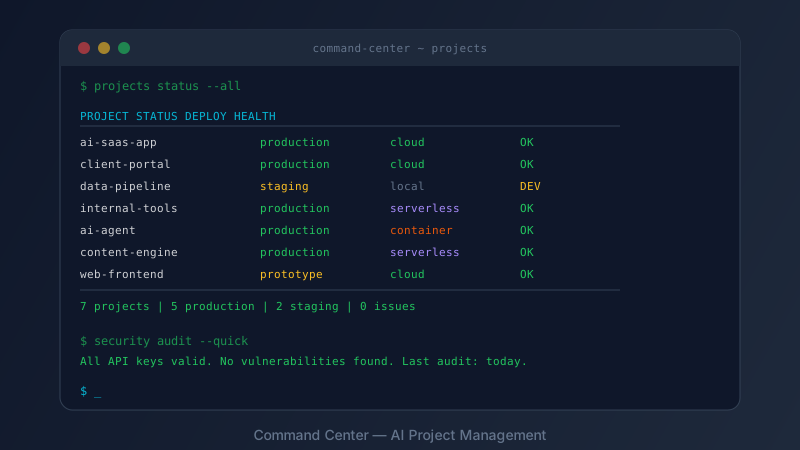
Context
We keep hearing: “AI is the future.” But what does that mean today, for a real business, in a real week?
This article is the answer. Not theory — but a 5-day chronicle where our AI agent ecosystem built three full-fledged systems. Each has its own story, its own business goal, and measurable results.
System 1: The Autonomous Sales Machine
Problem
A service company receives hundreds of inquiries per month. Staff physically cannot write personalized first messages to every client, qualify their needs, prepare proposals, and follow up — while simultaneously serving existing customers.
The result? Data shows clearly: 65% of potential clients simply don’t receive a timely response — and go to competitors.
Solution
We built Sales AI V2 — an autonomous conversation management system with 13 steps that operates like an experienced sales manager.
How it works:
The system automatically classifies each new lead into three flows:
- HV (High Value) — potentially valuable clients (score ≥80). AI runs the full sales cycle: qualifying → proposal → feedback → closing
- AS (Auto-Sequence) — medium-value inquiries (20–79). Automated follow-up sequence with personalized messages
- NF (No Follow) — low-priority contacts (<20). Minimal engagement, resource conservation
At each step, AI generates the appropriate email — from first contact to proposal, from reminder to discount offer. When a client replies, AI analyzes the response and determines the next step. If they don’t reply — the system escalates or changes tactics.
The scoring algorithm considers 6 factors: client type (repeat or new), inquiry signal, traffic source, deal value, seasonality, and purchase history.
Result
| Metric | Before | With Sales AI V2 |
|---|---|---|
| First response | 4–24 hours | Target: minutes |
| Clients without response | Significant portion | Target: much less |
| Conversion | Low | Target: significantly higher |
| CRM costs | Off-the-shelf (expensive) | Custom system (cheaper) |
The system is currently in UAT (User Acceptance Testing) — running in parallel with the existing system to validate results in a real environment.
System 2: The AI Content Factory
Problem
The marketing team manages 16 product lines, each requiring content for 5+ channels — Facebook, Instagram, TikTok, email, blog. That’s hundreds of content pieces per month. Manually, this requires a full-time person, and quality inevitably fluctuates.
Solution
We built two interconnected tools:
Content Multiplier — automatically generates 11 content pieces from a single pillar article:
- 3 Facebook posts (link, engagement, fact format)
- 3 Instagram pieces (carousel, reel, story)
- 2 YouTube formats (short + full-length)
- 2–3 TikTok video concepts
- Email newsletter snippet
AI Content Dashboard — a central management system with a built-in AI editor:
- All content in a single view with statuses and comments
- “Improve” workflow — add a comment, AI automatically generates an improved version
- Iterative process: accept → reject → retry (each iteration improves on the previous)
- Version history (v1, v2, v3…) — full traceability
- AI chatbot with conversation memory — answers questions about campaign status
Result
| Metric | Manual | With AI Pipeline |
|---|---|---|
| Content from 1 pillar article | 1 piece | 11 pieces |
| Time per product | ~4 hours | ~30 minutes |
| Quality control | Manual review | AI iterative improvement |
| Products in dashboard | — | 16 |
Humans still make the final decision — but AI takes on the bulk of the routine work.
System 3: The Business Auto-Optimizer
Problem
How do you know if your email campaign, SEO meta tags, or sales follow-up messages are optimal? Traditionally — A/B testing, which takes weeks and lots of manual work. And even then — you only see what you’re looking for. What about trends you didn’t even think to search for?
Solution
We adapted Andrej Karpathy’s autoresearch concept for business metrics optimization. Karpathy used it for automating machine learning experiments — we brought it to real business.
Auto-Optimizer works in a simple cycle:
- Modify — AI generates a new variation (email subject, meta description, follow-up message)
- Measure — the system measures results (open rate, bounce rate, conversion) via integrated data sources
- Keep/Revert — if the improvement is statistically significant, keep the new version. If not — revert to previous
- Repeat — the cycle continues automatically
Additionally, we built an Executive Dashboard with real-time data from all channels — both paid and organic:
- Paid channels: Facebook Ads (Meta API), Google Ads — spend, ROAS, CPC, conversions
- Organic traffic: SEO rankings, Plausible analytics — page views, bounce rate, session duration
- Sales data: CRM pipeline analysis — deal stages, stage-by-stage conversion, average deal value
- Email: MailerLite metrics — opens, clicks, unsubscribes
Built-in AI Analyst — doesn’t just display data, but actively searches for opportunities:
- Automatically identifies anomalies and trends across all channels
- Compares channel effectiveness and suggests budget reallocation
- Generates specific improvement recommendations with projected impact
- Answers questions in natural language: “Why did conversion drop last week?”
The insight that changed perspective: Analyzing historical sales data, the AI Analyst identified that one paid channel showed a 79% non-response rate — compared to 50% average from other channels. This single insight immediately redirected budget decisions and saved thousands of euros per month.
Result
This system is in its early stages, but already provides three fundamental advantages:
- Automated optimization — no more waiting for someone to manually set up an A/B test
- Data discoveries — the AI Analyst reveals trends that manual analysis would simply miss
- Complete picture — all channels in one view, paid and organic side by side, with a comparable metrics framework
The Big Picture
Three systems, five days, one conclusion: AI is not a tool you use piece by piece. It’s an ecosystem that works together.
Sales AI classifies leads → Content pipeline generates content that attracts them → Auto-optimizer measures what works and improves it.
Each of these systems could be built separately. But together they create an effect greater than the sum of their parts — because each system feeds the others with data and insights.
And this isn’t theory. This is work that a real team completed in a real week for a real business.
Does your business have processes that AI could automate? Get in touch — free consultation about your opportunities.