Radio Viens: a star factory with no people in it — how Latvia's first AI radio station works
More than ten artists with a fixed voice and character, 61 songs on air, a broadcast that rebuilds itself every night, and seven directors — none of them human. What it is, how it works and what it opens up.
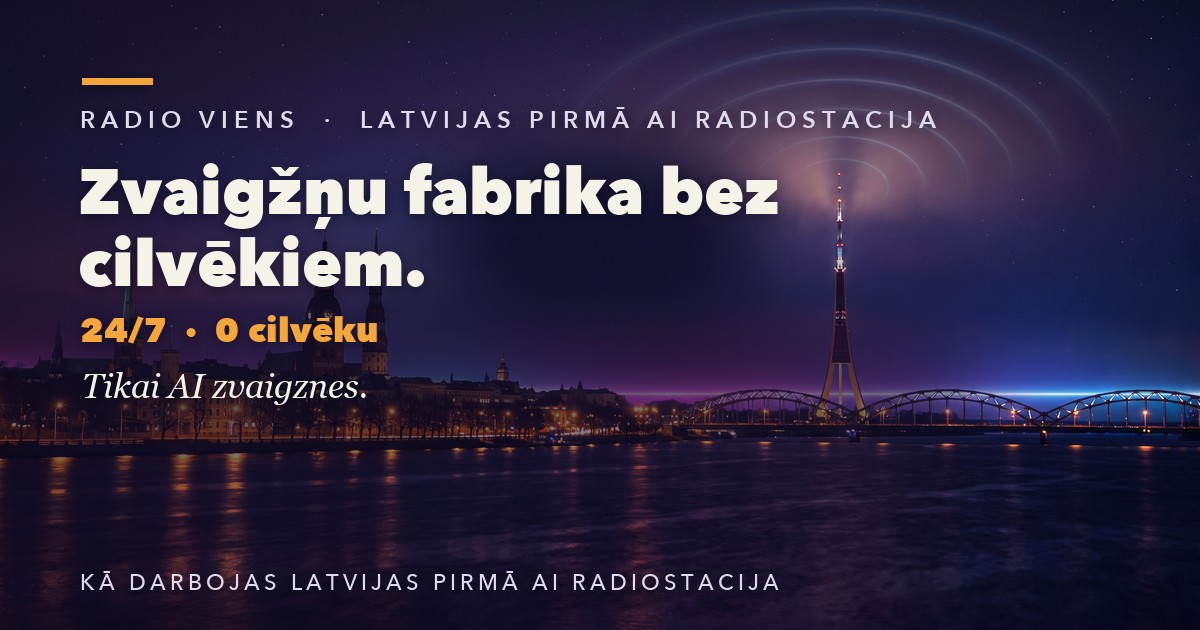
Radio Viens (“Radio One”) broadcasts in Latvian around the clock — radioviens.lv, TuneIn, YouTube. Songs, a voice between them, news, name days, a bedtime story. And not a single person. Every artist, every song and every spoken sentence is made by us, in our own studio, with artificial intelligence as the tool. We say so openly.
Latvian has fewer than two million speakers. No major music market will ever serve it. Everything below was built for that hardest case — and it works.
Not a playlist on a loop, a station
The broadcast runs from our own server in Europe on the same kind of equipment real internet radio stations use, with a backup that takes over automatically if anything goes wrong. On top of it — our own content factory: the programme, the voice, the news, quality checks and watchdogs that make sure every hour that what is on air is what should be.
Honestly, the technical stack was never the challenge; you can buy it. The hard part was quality content. But since we have our own powerful AI stack, we generated the technical side along the way.
A broadcast that rebuilds itself every night
Every night the server builds the next day from scratch: four dayparts with their own mood and songs, rotation without repeats, texts written for that day, news four times a day with sources and a seven-day memory. Before air — gates that take nothing on trust: every song by file fingerprint, Riga’s date, today’s news, standard loudness, and after the switch, real bytes verified with speech recognition. If anything fails, yesterday stays on air. The system never goes silent and never lets a broken programme through.
Artists are personas
Radio Viens is a label and a star factory, not a generator. More than ten artists, each with a niche and a world: L/AURA — elegant melancholic electropop with a real flute in every song; KRASTS — Baltic Britpop about Riga rooftops and the sea; ELZA — a raw rock voice; NEONA — neon city nights; GRANĪTS — biker rock; RAJONS — melodic hip hop; DATOW — eighties synthpop; Dzintari — seaside reggae; Saulrieta Bulvāris, DZELME, MARTA, VILKS. No two may duplicate each other.
Continuity is held by a sound DNA: a fixed voice anchor, a style reference, an arrangement library without repeats, signature instruments and a never-list. The brief for a new song is generated by the system, not written from memory — and it refuses if the artist lacks a voice reference. Character is held just as strictly: GRANĪTS has no factories, L/AURA’s elegance comes from restraint.
Us versus the big AI models
The voice has been the hardest part. Latvian has two “e” sounds, and generative models sing the wide one where the narrow one belongs — to a Riga ear, a dialect. It is not only a music problem: listen to the big AI models’ voice assistants speak Latvian — they consider the same pronunciation correct. No large model will learn a small language’s true sound on its own. This fight is ours.
So it would not stall everything else, we accepted a compromise early and aired some songs where the “e” was not yet clean. Every song has made us better; in the latest tracks the problem is almost entirely solved.
How hard a hit is
“Type a description, get a song” — which is exactly why such a song is worth nothing. Here a hit is days of work over several rounds.
Lyrics: a brief with a concrete situation → several angles → several complete candidates → hard gates (syllables, rhymes, chorus, risky-pronunciation words) → side-by-side with benchmarks → the human chooses. Music: first the hook — forty seconds of chorus in variants; the human picks the melody, and only from it the full song grows. Each round, several takes through a sieve and a montage — one minute instead of nine clips, the human names a number. The approved take becomes a master with measured loudness, dynamics and spectrum; approval is bound to the file’s fingerprint. Then the version family: live, night instrumental, acoustic.
For every song that reaches air, at least ten are thrown away — including ones that sounded good, but not good enough. Today 61 songs are on air. The last gate is always human ears.
Who runs it
A board of directors, none human: programme, music, marketing, technical and stream directors, a news editor, and an executive director who accepts nothing as done without proof. Each has a charter, an inbox and limits; every rule learned lives in a script that refuses to run if broken. There is one human — taste and decisions.
That is why an hour costs almost nothing, and why we can talk about what traditional radio cannot: no advertiser, no management. About how people live — never about who holds power.
What it opens up
- Every artist is a brand — the catalogue is our own IP with near-zero marginal cost.
- Language is a variable — Latvian is the hardest case; Estonian, Lithuanian, Finnish are the same system with a different dictionary.
- Radio as a service — a station for a region, a community or a company is a configuration, not a project.
- The method — a system that builds, checks and guards a real operation every day on its own is not tied to radio.
The audience is still small, and we measure it rather than inflate it. The product is built; now begins the part where people start to hear it.
AI news for business leaders
Twice a week: what AI news means for a small business. No hype, with concrete steps.