Radio Viens Isn't a Playlist Looping on YouTube — It's a Real Radio Station Without a Building
Radio Viens looks like a playlist on a loop, but underneath runs a fully autonomous AI radio station that writes, checks, and fixes its own broadcast every night. A deliberate MVP — proof that an autonomous AI system can take over a real operation one-to-one.
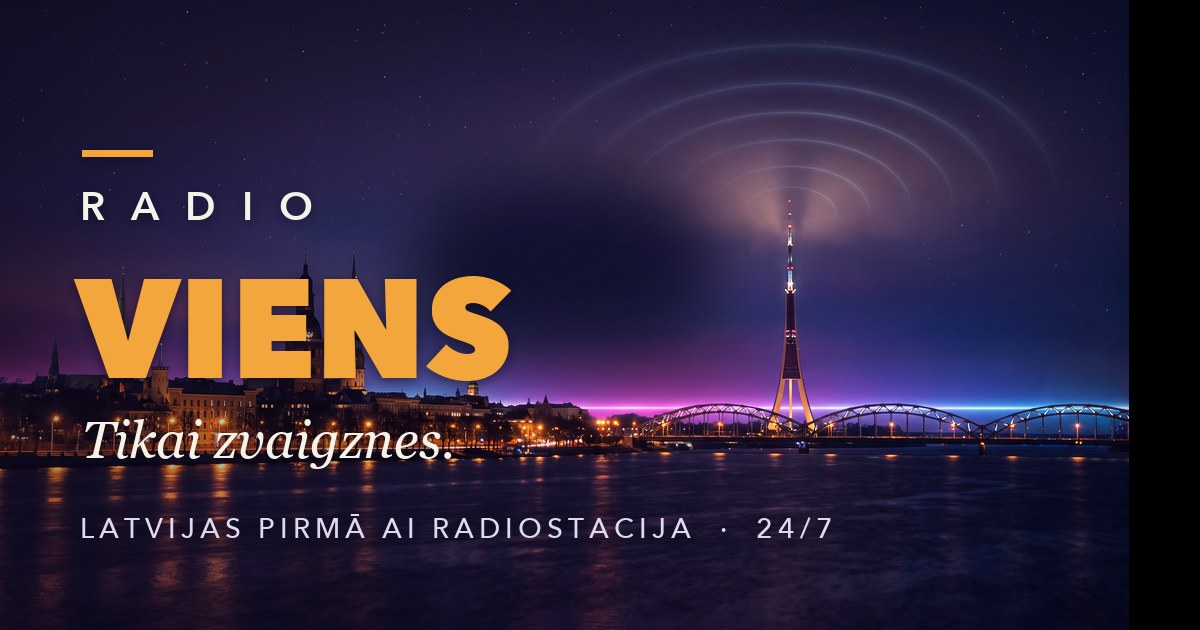
When someone first comes across Radio Viens, the reaction is usually quick: “Ah, got it — a playlist that just keeps spinning.” From the outside, it really can look that way. Songs follow one another, an announcer speaks between them, and there’s a non-stop live stream online.
But what the listener hears is not a list put together yesterday and repeated to infinity. Underneath runs a full autonomous system. It was built to test one very practical question: can AI not just create something, but keep a whole operation alive every single day?
What Radio Viens really is
Radio Viens is an openly artificial-intelligence radio station in Latvian. It isn’t hidden — on the contrary, that is the foundation of the whole project. AI makes the music, the announcer, the news, the weather forecast, and the daily program. All of it in Latvian.
The catalogue already holds more than thirty original songs that exist nowhere else in the world. They can be heard by someone in Riga, in Toronto, in Melbourne, or anywhere else a person goes online looking for content in their own language.
But the main story isn’t that a machine can write a song. More and more systems can do that today. What matters begins afterwards: how those songs become a repertoire, how the day’s broadcast comes together, and how the system makes sure the listener gets what was promised.
The artists aren’t random AI output
Radio Viens songs are not random pieces the AI made and then forgot. Behind them is a deliberate artist strategy.
There is a genre map, where every artist has its own place — pop, rock, rap, electronic, schlager, country, and other directions. Each also has a consistent voice identity. If a given artist sings one song today, tomorrow it won’t sound like a completely different person. The listener has to be able to feel that it’s one and the same personality, not a random voice for every new recording.
Before a song even reaches the air, it passes a quality gate. The principle is simple: only stars make it on air. Not every technically finished song is good enough for others to listen to. That standard matters more than the wish to fill the catalogue quickly.
Why it isn’t a static list
A playlist is static. It’s put together once, and it keeps spinning until someone stops it. It knows nothing about today, checks nothing itself, and fixes nothing itself.
Radio Viens works the opposite way. Every night it writes the next day’s broadcast from scratch. Around midnight, the system assembles the program, chooses the songs and their order, writes the lines the announcer needs, turns them into speech, and mixes it all into one flowing broadcast. The song fades before the announcer starts to speak — it isn’t simply cut off mid-word.
Then the system checks its own work. Built into the broadcast are gates that physically halt the build if something is wrong. If the announcer is about to introduce a song with the wrong artist, if yesterday’s date appears in the text, or if an intro doesn’t match the next song, the broadcast isn’t released any further.
A list notices no such errors. Radio Viens doesn’t let them through unchecked.
And it has its own newsroom
Radio Viens isn’t limited to music. It has a news department that prepares a fresh news block every day — the day’s events and the weather — and weaves it into the program. The news too passes the language quality check, and yesterday’s date never airs.
It’s run by a team of six AI directors
The station isn’t driven by one program running off somewhere on its own. It’s run by a team of six AI directors, and each has a clear area of responsibility.
The music director looks after the repertoire and new songs. The program director builds the broadcast and the announcer’s texts. The technical director is responsible for the systems and is the only one allowed to touch the servers. The stream director makes sure the sound actually reaches the listener. The marketing director watches over the brand and the audience. And the executive director coordinates the whole team and answers for one essential thing — the truth.
The directors communicate through file mailboxes. Every piece of work is recorded in an accountability ledger, so it’s clear what was done, what the system concluded, and who answers for the result. Every more serious mistake goes through a root-cause analysis before anyone is allowed to simply “fix” it. If one problem repeats, a mandatory investigation begins.
This is not decorative theatre. Every one of these rules was born after a real mistake that once reached the air.
Where the human remains
The human doesn’t disappear anywhere. Their role is deliberately narrowed to what machines still can’t safely replace: taste and decisions.
The human approves new songs, catches with their ears what a test might miss, and sets the direction. Everything else — from the song lyrics to the broadcast, from the news to crash recovery — happens on its own.
In a single week the station lived through a nineteen-hour silence crisis, a brand change, a full rebuild of the news mechanism, and a move to a new code home. The listener heard nothing more than music through all of it.
Then, at 00:33, the system built the morning program completely alone for the first time. Without a night shift, without approval. In the morning the announcer said the correct date, and it emerged from the recording, not from an overnight watch.
Why this story matters
Radio Viens is not a hobby with songs. It is a deliberate MVP — a fully working prototype whose job is to prove one idea: that a fully autonomous AI system can take over a real operation one-to-one and keep it alive with no human at the wheel.
The radio here is the first tested operation — a full clone of a radio station. The human doesn’t disappear in it; they move to taste, standards, and responsibility. And the gates, the proofs, the ledgers, and the rules born from mistakes are not bureaucracy. They are what separate a flashy demo from a system you can actually trust with the work.
This approach isn’t tied to radio. It fits anything that has to run every day and cannot afford to stop. If, reading this, a particular industry comes to mind, that’s not a coincidence.
Radio Viens is a personal project — which is why it can be talked about so openly. The others are client work kept quiet, but the approach behind them is the same. Radio Viens is the first clear proof: a real radio station can exist without a building, if it has a system that can build, check, launch, and guard its own broadcast on its own.
Don’t take it on words alone — listen for yourself. Radio Viens broadcasts live around the clock:
AI news for business leaders
Twice a week: what AI news means for a small business. No hype, with concrete steps.